You have successfully logged out.

Selecting surgical needles is a clinical and procurement decision, not a simple price comparison. Needle shape, point type, curvature, and suture compatibility affect handling in different tissues. Packaging, sterility assurance, and traceability also deserve careful review. Small details matter.
The Lancet Commission on Global Surgery estimated that five billion people lacked access to safe, affordable surgical and anesthesia care. It also estimated that 143 million additional procedures were needed each year in low- and middle-income countries. These figures describe access gaps, not needle performance. Still, they underline why reliable supplies and sound purchasing decisions matter. The World Health Organization’s Global Guidelines for the Prevention of Surgical Site Infection also stress evidence-based prevention practices across surgical care. A needle alone cannot prevent infection, but product quality belongs within a broader safety system.
For teams exploring Needles Surgery, the right choice depends on the procedure, tissue, clinician preference, and facility requirements. A fine taper-point needle may suit delicate tissue, while a cutting point may be selected for tougher tissue. Yet product names and catalog images can hide meaningful differences. Even experienced buyers can overlook compatibility or handling concerns when comparing specifications too quickly. That is worth revisiting. This guide presents seven practical tips for evaluating surgical needles, checking documentation, comparing suppliers, and balancing cost with consistent performance. Use it alongside clinical protocols and qualified procurement advice.
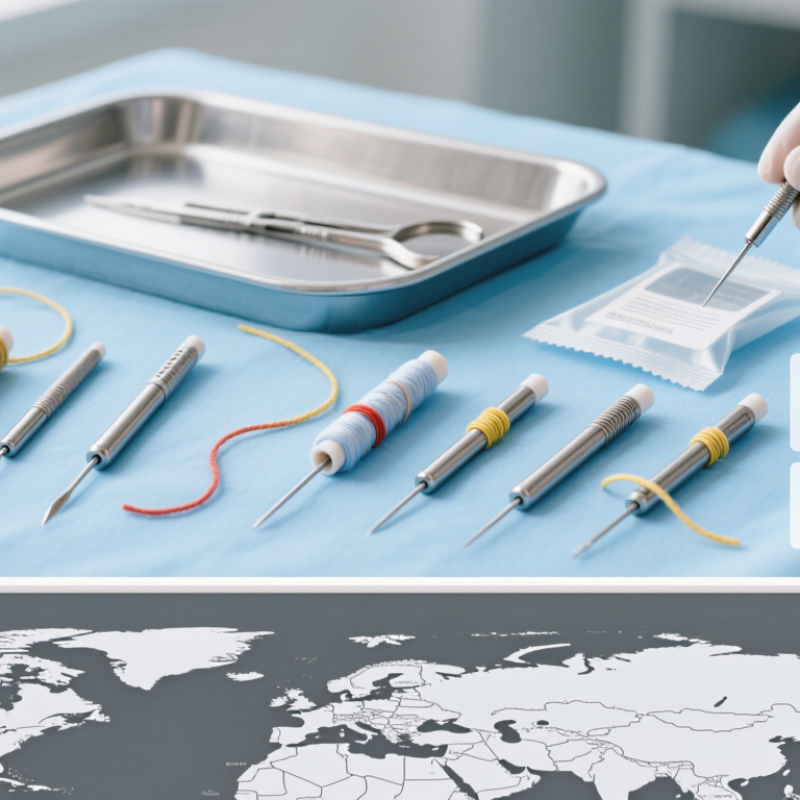
Define the procedure before comparing needle specifications. A short skin incision, a deep abdominal closure, and delicate vascular repair place different demands on needle shape, point, and curvature. Match the needle to the tissue: taper points generally separate soft tissue fibers, while cutting points can penetrate tougher tissue such as skin. Consider tissue thickness, fragility, access angle, and the number of layers being closed. A needle that is too large may create unnecessary trauma; one that is too small can make controlled passage difficult. Small details matter.
Use the operative plan, not a generic “one needle fits all” rule. For confined access, curvature and needle length affect maneuverability; for friable tissue, avoid choosing a point solely for easy penetration.
A tidy selection chart can still miss the real case. Confirm the intended suture-and-needle combination against the procedure requirements, product instructions, and clinical protocol.
Needle point and curvature should match the tissue, access angle, and suture size. A taper point separates soft tissue fibers rather than cutting them, making it useful where tissue tearing is a concern. For tougher tissue, a cutting or reverse-cutting point can penetrate more readily. Small details matter. Reverse-cutting designs place the cutting edge along the needle’s outer curve, which may help reduce cut-through, though tissue quality and technique still affect results.
Curvature shapes the needle’s path. A 3/8-circle needle often suits accessible, broad fields; a 1/2-circle curve can help when the working space is deep or restricted. Straight needles may be practical when tissue is easy to reach directly. A Lancet analysis by Weiser and colleagues estimated 234.2 million major operations worldwide in 2004, underscoring the scale of surgical care—but it does not identify one best needle shape. Not always obvious. Compare the needle’s arc with the actual approach angle, and check whether the point enters cleanly without excessive force. In practice, the “ideal” geometry can be less clear than a catalogue suggests; surgeon preference and tissue variation deserve consideration.
| Tip | Needle point to consider | Curvature to consider | Typical use and selection notes |
|---|---|---|---|
| 1. Match the point to tissue density | Taper point | Often 3/8 or 1/2 circle, depending on access | A taper point separates rather than cuts tissue fibers. It is commonly considered for soft tissues such as bowel or blood vessels. Confirm that the tissue is suitable for a non-cutting point. |
| 2. Consider a cutting point for tougher tissue | Reverse cutting or conventional cutting | Commonly 3/8 circle for accessible tissue | Cutting points can penetrate dense tissue such as skin. A reverse-cutting point places its third cutting edge on the outer curve; this design may help reduce cut-through at the wound edge compared with a conventional cutting point. Follow procedural preference. |
| 3. Evaluate taper-cut designs for dense tissue | Taper-cut | Often 1/2 circle, subject to the site and access | A taper-cut needle combines a cutting tip with a tapering body. It may be considered when a standard taper point is difficult to advance through dense or fibrous tissue, such as some fascia or cardiovascular tissues. |
| 4. Protect fragile, easily damaged tissue | Blunt point | Often 1/2 circle, depending on the operative site | A blunt point is designed to spread tissue rather than sharply penetrate it. It may be used for friable tissues, including liver or kidney, when appropriate to the procedure and surgical technique. |
| 5. Match curvature to the available working space | Select the point for the tissue first | 3/8 circle for relatively accessible sites; 1/2 circle for deeper or more confined sites | A 3/8-circle needle generally needs more room to sweep through tissue. A 1/2-circle needle can be useful in a deeper or restricted field, but the best choice depends on the anatomy, instrument control, and procedure. |
| 6. Consider a smaller arc for delicate, shallow work | Fine taper or specialty point, as indicated | 1/4 circle or a specialty shallow-arc design | Smaller arcs can suit selected delicate or shallow procedures where a broad needle sweep is impractical. Ophthalmic procedures may use specialized needle designs; choose according to the specific tissue and surgical technique. |
| 7. Check the complete needle-and-suture specification | Verify point geometry and needle size | Verify the stated arc and needle length | Before purchase, compare the needle description with the intended tissue, access, and suturing method. Also confirm suture material and size, packaging, sterility, and compatibility with local clinical requirements. |
Selection depends on the procedure, tissue, access, and clinician preference. Follow applicable clinical protocols and product instructions.
When comparing surgical needles, look beyond the size label. Check needle length, curvature, and diameter against the intended tissue and access point. A short, tightly curved needle may suit a confined field, while a longer curve can provide reach. Smaller is not always gentler. Confirm the dimensions on the product specification sheet, since labels alone may not show the full geometry.
Compare point style and material as well. A taper point separates tissue fibers; a cutting point is designed to penetrate tougher tissue. Match the choice to the procedure and follow the clinical team’s established protocols. Many needles use stainless steel, but alloy composition and surface finishes vary. Review material and coating details for compatibility with the intended use. One easy-to-miss detail: a smooth finish does not guarantee the needle will handle the same way in every tissue.
Check suture compatibility before placing an order. Match the needle’s attachment type and size with the suture, then verify both against the manufacturer’s stated range. A mismatch can affect handling or secure attachment. Compare packaging, sterility information, and lot traceability, too. This comparison is not perfect; purchasing teams may weigh cost heavily, while clinicians prioritize feel and control. Ask end users to assess samples when appropriate, and document why the selected size and material fit the intended application.
Sterility depends on more than a “sterile” label. Check the sterilization method, lot number, expiry date, and traceable release records. Inspect each pouch for punctures, dampness, broken seals, or crushed corners. A tiny tear matters. WHO’s 2016 Global Guidelines for the Prevention of Surgical Site Infection report that surgical site infections affect up to 11% of patients undergoing surgery in low- and middle-income countries. That figure is not specific to needles, but it underlines why every sterile item needs careful handling.
Packaging should protect the needle through shipping, storage, and opening at the point of use. Look for clear instructions, intact seals, and packaging validated for the stated sterilization process. ISO 11607 addresses packaging for terminally sterilized medical devices; ask suppliers how their packaging meets applicable requirements. Match needle type, size, curvature, and point to the procedure, then confirm the product meets the relevant device specification. Small differences matter in the hand.
Supplier reliability deserves the same scrutiny as the product. Request current quality documentation, batch-level traceability, and a clear process for handling damaged or recalled stock. Check whether delivery conditions preserve packaging integrity, especially after long transit or temperature swings. A polished certificate is not the whole story. I would still ask one awkward question: who investigates a seal failure, and how quickly can they identify affected lots? A dependable supplier should answer plainly, without making traceability feel like an afterthought.
Tip one: Compare total landed cost, not just the unit price. Include freight, storage, inspection time, and expected waste. Tip two: Match needle curve, point, and size to the procedure and suture material. A cheaper needle is poor value if it slows handling. Tip three: Check lead times and recent fill rates. Ask suppliers how they report backorders, substitutions, and delivery changes. Small delays matter.
Tip four: Assess performance using practical measures: penetration consistency, secure suture attachment, and resistance to bending or breakage. Review product specifications, then evaluate samples under your facility’s approved process. Tip five: Verify sterile packaging, clear lot identification, and usable expiry dates on received stock. WHO’s 2022 Global Report on Infection Prevention and Control estimates that healthcare-associated infections affect 7 in 100 patients in acute-care hospitals in high-income countries, and 15 in 100 in low- and middle-income countries. These figures cover all such infections, not needle defects, but they reinforce the value of careful sterile-supply checks.
Tip six: Compare like with like. Record needle type, size, pack quantity, and delivery performance, or price comparisons can mislead. Tip seven: Review a small trial with the clinical team before changing routine orders. Track complaints and reorders. Be willing to revise the scorecard; a neat spreadsheet can miss what clinicians feel at the needle holder.
Evaluate cost, availability, and product performance. Needle curvature is one practical specification to compare.
Common needle curvatures: The chart shows the approximate arc angles represented by standard curvature names. The right choice depends on the procedure, access, and tissue; check each product’s specifications.