You have successfully logged out.

China Best Chaga Powder Supplier for Bulk Buyers?
Bulk buyers comparing suppliers in China need more than a low quoted price. Chaga Powder should be evaluated through species identification, processing details, traceability, and batch documentation. A polished sample is useful, but it cannot tell the whole story.
Mycologist Paul Stamets has called mushrooms “miniature pharmaceutical factories.” His observation concerns mushrooms broadly, not a guarantee about Chaga or any powder. For buyers, the practical lesson is to examine what each batch contains and how the supplier verifies it. Request the Latin species name, origin, processing method, and a recent certificate of analysis. Check whether testing covers identity, contaminants, and relevant quality specifications. Ask how samples compare with bulk production. Details matter.
A dependable supplier should answer clearly and provide records that match the offered lot. Compare particle size, moisture information, packaging, lead times, and minimum order quantities. Where applicable, confirm that stated quality standards are supported by current documentation. Do not treat attractive photographs or sweeping health claims as proof. Not every batch behaves alike. Even a careful review has limits: documents can be incomplete, and a sample may not represent a future shipment. That is a reason to ask better questions, not to assume bad faith. This guide outlines practical checks for assessing a China-based Chaga Powder supplier before making a bulk commitment.
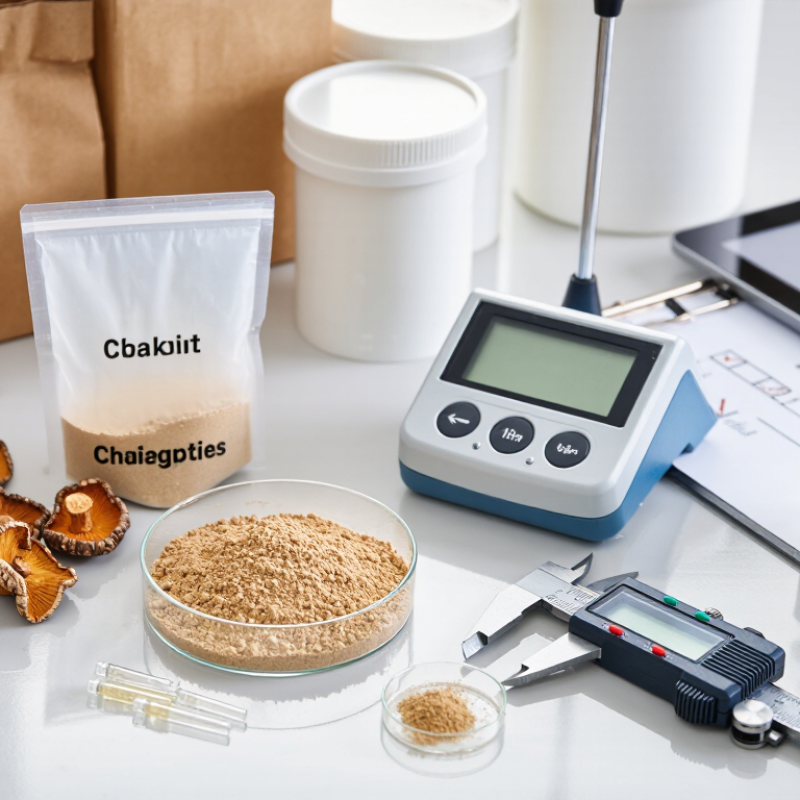
What Is Chaga Powder and How Is It Produced?
What Is Chaga Powder and How Is It Produced?
Chaga powder is made from Inonotus obliquus, a fungus that forms a dark, hardened growth on birch trees. It is not a cultivated mushroom cap. The material is collected, checked for species identity, and cleaned to remove bark and debris. It is then dried and milled into powder. Simple steps, but each affects the final product.
Drying should limit moisture without scorching the material; milling creates a fine, brown powder with a woody smell. Bulk buyers should ask for batch-specific identity, moisture, and contaminant testing, plus details on whether the product is plain powder or an extract. They are not interchangeable.
The raw-material story is less tidy than a label suggests: tree, location, harvest, and processing can all shape consistency. FAOSTAT recorded roughly 11.9 million tonnes of mushrooms and truffles worldwide in 2022, but that broad figure is not a Chaga supply estimate.
Not quite.
It does show why general mushroom statistics cannot verify a Chaga supplier’s capacity. Check the records behind the claims, not only the powder’s appearance.