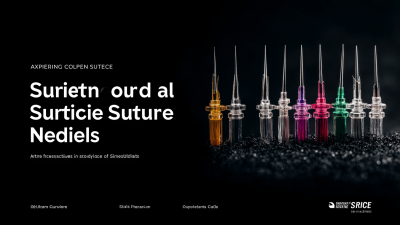
You have successfully logged out.

Choosing Needles And Sutures for global sourcing is a clinical, technical, and supply-chain decision. It is not merely a price comparison. The Lancet Commission on Global Surgery estimated that about 313 million surgical procedures occur worldwide each year. That scale increases pressure on hospitals, distributors, and manufacturers to secure consistent, safe products.
Start with intended use. Needle curvature, point geometry, diameter, and penetration force should match the tissue and procedure. Suture selection also depends on tensile strength, absorption profile, coating, and handling. A 3/8-circle needle may suit accessible tissue, while a 5/8-circle design can support deeper closure. Small differences matter. They affect control.
Global buyers should request documented compliance with applicable standards, including relevant ISO requirements, biocompatibility evidence, sterilization validation, and batch traceability. The World Health Organization’s Global Guidelines for the Prevention of Surgical Site Infection emphasize evidence-based practices across the surgical pathway. Packaging must protect sterility during transport, storage, and opening. Check seal integrity, expiry dates, labeling languages, and temperature controls.
Cost still matters, but the lowest quoted price can hide higher failure risks. Compare unit cost, defect rates, lead times, inspection records, and supplier continuity. Ask for samples before approving a large order. Inspect needle alignment, suture memory, crimp security, and package seals under realistic handling conditions. This guide cannot replace clinical judgment or local regulatory review. That limitation matters. Requirements differ by destination market, facility type, and procedure. Reliable sourcing therefore combines supplier experience, verified documentation, independent quality checks, and careful communication from specification to delivery.
Choosing needles and sutures should begin with the procedure, not the catalog. A skin closure needs different handling than vascular, ophthalmic, or orthopedic repair. Define tissue strength, access depth, expected healing time, and surgical technique. Needle curvature, point geometry, diameter, and body strength must match the target tissue. For delicate tissue, a sharp, fine needle may reduce trauma. For dense tissue, a stronger body may matter more. The decision is clinical.
Write these requirements into a sourcing specification. State suture size, length, construction, coating, absorbability, color, and packaging format. Include sterility status and shelf-life expectations. Ask suppliers for material documentation, batch traceability, sterilization validation, and consistent inspection records. Requirements should reference recognized medical-device quality systems and destination-market rules. Do not assume one certificate satisfies every country. Import documents, labeling languages, registration pathways, and post-market responsibilities can differ. Small omissions create expensive delays.
A practical evaluation uses samples from multiple lots, not one attractive sample. Clinicians should assess needle penetration, grip, memory, knot security, and tissue drag under realistic conditions. Procurement teams should compare defect rates, lead times, minimum order quantities, and change-control procedures. Cost still matters, but a cheaper unit can increase waste or revision risk. This is where judgment becomes uncomfortable. Specifications may look complete while missing the surgeon’s actual preference. Review them with clinicians, quality specialists, and regulatory staff before approval. Perfect certainty is unrealistic. Document every revision clearly.
Choosing needles and sutures for global sourcing requires more than matching a product code. The tissue decides the design.
Taper-point needles spread fibers and suit soft, easily penetrated tissue. Cutting needles have sharp edges for tougher tissue. Reverse-cutting points reduce the risk of tearing during passage. Blunt needles can help in friable tissue, but they require careful handling. Small details matter. A 3/8-circle needle offers good control in open fields. A 1/2-circle needle reaches deeper spaces with less wrist movement. A 5/8-circle shape may work better in confined cavities. Straight needles support direct, surface-level stitching.
Needle size combines length, diameter, and curvature. A longer needle can improve reach, yet it may feel less precise. Larger diameters improve strength but create more tissue disruption. Gauge descriptions can vary between suppliers, so confirm the actual dimensions. Ask for samples, technical drawings, sterilization details, and lot traceability. Check the needle-suture attachment, pull strength, point sharpness, and packaging integrity. I have found that visual inspection alone misses important defects. Performance testing is still necessary. Do not rely on a catalog photograph. Material compatibility, suture absorbability, and handling memory also affect clinical performance. One selection may look efficient on paper, then perform poorly in a real procedure. That possibility deserves honest review.
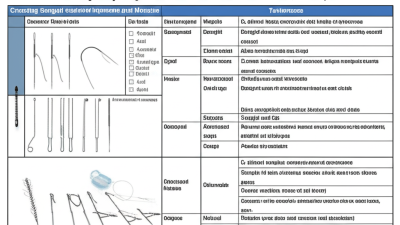
Compare needle types, points, curvatures, and sizes using standardized needle geometry.
Straight needles are useful for accessible surfaces. Curved needles rotate through tissue and are commonly specified as 1/4, 3/8, 1/2, or 5/8 circle. The chart shows the corresponding arc angles.
Taper points spread fibers and are used for soft tissue. Cutting and reverse-cutting points have cutting edges for dense tissue such as skin. Blunt points reduce the risk of penetrating fragile tissue.
USP suture sizing follows the convention that more zeros generally indicate a finer suture. Always confirm the actual diameter, tensile strength, needle attachment, sterilization status, and regulatory documentation with the supplier.
Arc angles are based on standard fractional-circle needle geometry: 1/4 circle = 90°, 3/8 circle = 135°, 1/2 circle = 180°, and 5/8 circle = 225°.
Suture selection begins with material behavior, not catalog price. Absorbable options suit tissue that regains strength during healing. Polyglycolic acid loses strength relatively quickly. Polydioxanone maintains support longer. Nonabsorbable materials may support permanent repairs but can increase long-term foreign-body concerns.
According to Grand View Research’s 2024 market analysis, absorbable sutures represented the largest product segment in 2023. The report estimated the global surgical sutures market at approximately USD 4.5 billion that year. Estimates vary across research firms.
Structure changes handling and infection-control considerations. Monofilament sutures pass smoothly through tissue and reduce surface areas where contaminants may lodge. Braided sutures offer better knot security and handling. Coatings can reduce drag, but they may also change flexibility and tissue response.
Needle selection should match tissue density. A cutting needle suits tougher tissue, while a taper needle generally reduces disruption in softer tissue.
Small details matter.
Absorption profiles require careful comparison with healing timelines. A rapidly absorbing suture may disappear before adequate support develops. A slower profile can maintain strength longer, but excessive persistence is not automatically better.
Fortune Business Insights projects continued growth in absorbable suture demand through 2032, driven partly by preference for procedures without removal visits. Forecasts are useful, not absolute.
I would not trust a single supplier chart. Test knot security, tensile retention, needle penetration, and packaging stability under local shipping conditions. One uncomfortable finding can prevent a costly sourcing mistake.
Global sourcing of needles and sutures should begin with evidence, not attractive pricing. Ask suppliers to provide ISO 13485 certification, product specifications, risk files, and recent audit findings. Needle dimensions, point geometry, tensile strength, suture diameter, and coating consistency need batch-level verification. ISO 10993 biological evaluation is also important when materials contact tissue. A certificate alone is not enough.
Sterility requires closer scrutiny. Request validation records for the stated sterilization method, such as ISO 11135 for ethylene oxide or ISO 11137 for radiation. Review bioburden testing under ISO 11737 and packaging validation under ISO 11607. Check seal strength, package integrity, expiry dating, and transport simulation.
The WHO Global report on infection prevention and control (2022) estimates that 7% of acute-care patients in high-income countries and 15% in low- and middle-income countries acquire at least one healthcare-associated infection.
Weak sterile-barrier controls can increase avoidable risk. Small gaps matter.
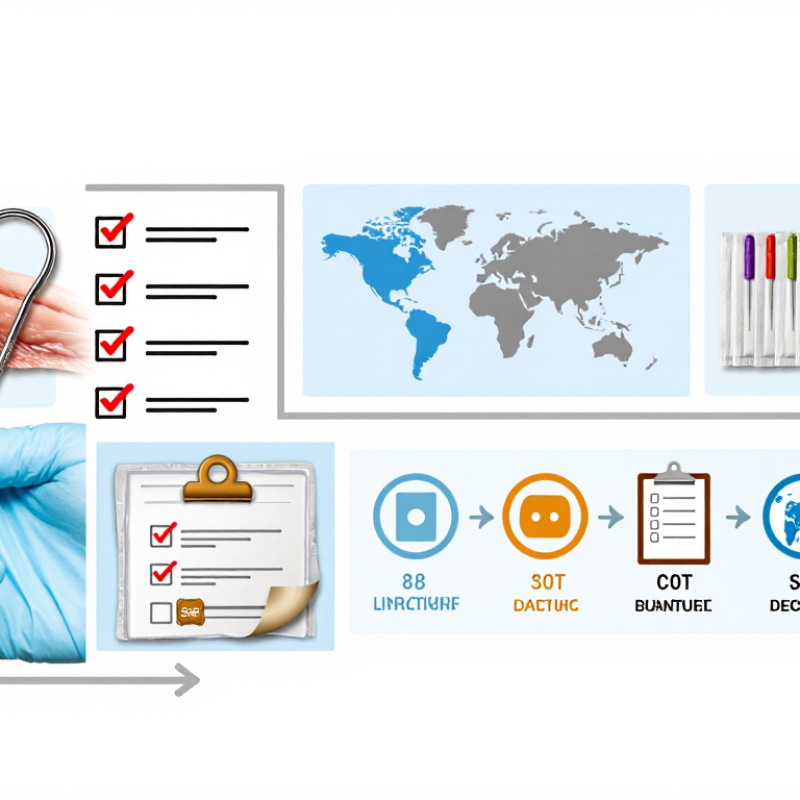
Tips: Build a supplier scorecard covering quality, sterility, traceability, complaints, and corrective actions. Sample products independently before approval. Confirm that every lot links to raw materials, operators, sterilization cycles, and release records. Supplier compliance may look strong on paper, yet subcontracted sterilization or undisclosed material changes can escape routine review. I would also re-audit after any process change. That step is easy to postpone. It should not be.
Choosing needles and sutures for global sourcing requires more than comparing catalog photos. Request physical samples with matching specifications, including needle gauge, point style, curvature, suture material, length, and coating. Inspect needle sharpness, bending resistance, thread memory, and package integrity. If possible, ask a qualified clinical or quality team to assess handling and simulated use. The first sample is rarely perfect.
Pricing should include more than the unit quote. Check minimum order quantities, sample charges, packaging, inspection costs, freight, insurance, duties, and payment terms. A low factory price can become expensive after delivery. Confirm whether the quotation covers sterile packaging and required quality documents. I once focused too closely on unit cost and missed a small packaging fee. That mistake changed the real comparison.
Tips: Build a comparison sheet for every supplier. Record sample results, revisions, quoted lead times, production capacity, and shipping options. Ask for a written timeline from order confirmation to dispatch. Add a practical buffer for holidays, port congestion, inspections, and customs delays. Use clear delivery terms and confirm who handles each logistics stage. Keep approval samples and final production samples traceable by lot. Do not rely on verbal promises. Written records are safer. Some details may still change, so review the plan before each purchase.
| Product Category | Typical Specification | Common Application | Sample Verification Points | Indicative Unit Price (USD) |
Typical MOQ | Sample Lead Time | Production Lead Time | Recommended Packaging | Typical Export Logistics | Key Compliance Documents |
|---|---|---|---|---|---|---|---|---|---|---|
| Surgical Needle | Stainless steel, 3/8 circle, reverse-cutting, 30 mm | Skin closure and general soft-tissue procedures | Tip sharpness Curvature Needle strength Surface finish | $0.018–$0.045 / needle | 50,000–100,000 needles | 7–10 business days | 25–40 business days | Individual sterile pouch or foil package; printed lot and expiry information | Air freight for urgent replenishment; sea freight for consolidated orders | ISO 13485 certificate, material specification, sterilization record, inspection report |
| Braided Absorbable Suture | Polyglactin-type or polyglycolic-acid-type fiber, USP 2-0, 75 cm | General soft-tissue approximation and ligation | Knot security Tensile strength Braid uniformity Absorption profile | $0.22–$0.48 / suture | 10,000–30,000 sutures | 10–15 business days | 35–55 business days | Single sterile pouch with carton separators to prevent tangling and abrasion | Sea freight is generally the lowest-cost option; air freight for smaller validated lots | Material certificate, biocompatibility evaluation, sterility validation, shelf-life data |
| Monofilament Absorbable Suture | Polydioxanone-type material, USP 3-0, 75 cm, 1/2-circle needle | Longer-term tissue support and pediatric procedures | Memory Flexibility Needle attachment Hydrolytic strength loss | $0.38–$0.85 / suture | 10,000–20,000 sutures | 12–18 business days | 40–60 business days | Moisture-protective sterile pouch with controlled storage conditions | Use moisture-resistant secondary cartons; avoid prolonged exposure to high heat | Polymer specification, accelerated-aging report, sterility record, packaging validation |
| Monofilament Non-Absorbable Suture | Polypropylene-type material, USP 4-0, 75 cm, blue or undyed | Vascular, skin, and cardiovascular soft-tissue closure | Diameter consistency Flexibility Knot retention Color stability | $0.28–$0.70 / suture | 10,000–25,000 sutures | 10–15 business days | 35–50 business days | Individual sterile pouch; protect against sharp carton edges and excessive compression | Suitable for air or sea freight; standard dry storage during transit | Polymer identity report, tensile test, biocompatibility data, sterilization certificate |
| Braided Non-Absorbable Suture | Polyester-type fiber, USP 2-0, 75 cm, coated or uncoated | Tendon, ligament, and other procedures requiring permanent support | Braid density Coating uniformity Abrasion resistance Knot security | $0.30–$0.78 / suture | 10,000–20,000 sutures | 12–18 business days | 40–60 business days | Sterile individual pouch with anti-abrasion handling and moisture-resistant cartons | Consolidated sea freight is cost-efficient; use air freight for qualification samples | Fiber and coating specifications, tensile test, biocompatibility report, sterility record |
| Stainless Steel Suture | 316L stainless steel wire, USP 5, 45 cm, straight or curved needle | Sternal closure, orthopedic fixation, and high-strength approximation | Corrosion resistance Wire diameter Bending strength Needle attachment | $0.45–$1.20 / suture | 5,000–10,000 sutures | 10–15 business days | 30–45 business days | Rigid protective packaging to prevent wire deformation and needle damage | Sea freight is suitable; use protective moisture barriers for long routes | 316L material certificate, corrosion test, tensile test, sterilization documentation |
| Ophthalmic Suture | Monofilament nylon-type material, USP 10-0, 30 cm, fine curved needle | Ophthalmic microsurgery and delicate tissue repair | Microscope inspection Tip geometry Ultra-fine diameter Needle smoothness | $0.65–$1.80 / suture | 5,000–10,000 sutures | 15–20 business days | 45–65 business days | Individual protective sterile package with strict control of bending and vibration | Air freight is preferred for traceability and reduced handling time | Dimensional inspection, needle performance test, sterility validation, shelf-life report |
| Suture with Attached Needle | Pre-attached needle and suture combination; selected USP size and length | Routine surgical closure, dental procedures, and wound repair | Attachment pull-out Needle penetration Length accuracy Package seal | $0.20–$1.80 / set | 10,000–30,000 sets | 10–18 business days | 35–60 business days | One sterile set per pouch; cartons labeled with size, lot, expiry, and sterilization method | Confirm HS classification, import labeling, and destination-country medical-device rules | Technical file, ISO 13485 certificate, sterilization certificate, batch release record |