You have successfully logged out.
How to Find a Top Medical Uniform OEM Partner in China?
Choosing a Medical uniform OEM partner in China takes more than comparing unit prices. Fabric swatches, stitch quality, sizing consistency, and delivery records reveal how a supplier performs in practice. The World Health Organization’s Global Strategy on Human Resources for Health: Workforce 2030 projects a global shortfall of 10 million health workers by 2030. That pressure makes dependable uniform supply important, but it does not predict any buyer’s order volume. Context matters.
Market reports can help frame the opportunity. Grand View Research’s Medical Clothing Market analysis tracks demand across healthcare apparel, while noting that market estimates depend on product definitions and regional scope. Treat forecasts as indicators, not guarantees. A useful supplier review should go deeper: request fabric composition and test records, inspect samples after repeated washing, and compare measurements across sizes. Ask how the factory controls shade variation between production batches. Small differences show up quickly on a busy ward.
Check whether quality procedures are documented and whether claims can be verified. ISO 9001 certification may indicate a quality management system, but it does not prove that a garment meets your specific performance needs. For protective apparel, confirm the applicable requirements in your destination market and ask for relevant test evidence. A polished brochure is not evidence. Factory audits, clear defect-handling terms, and a pilot order can reduce uncertainty. No checklist removes every risk; even careful buyers can miss details. The goal is a partner whose claims stand up to inspection.
Define Your Medical Uniform Requirements and Sourcing Criteria
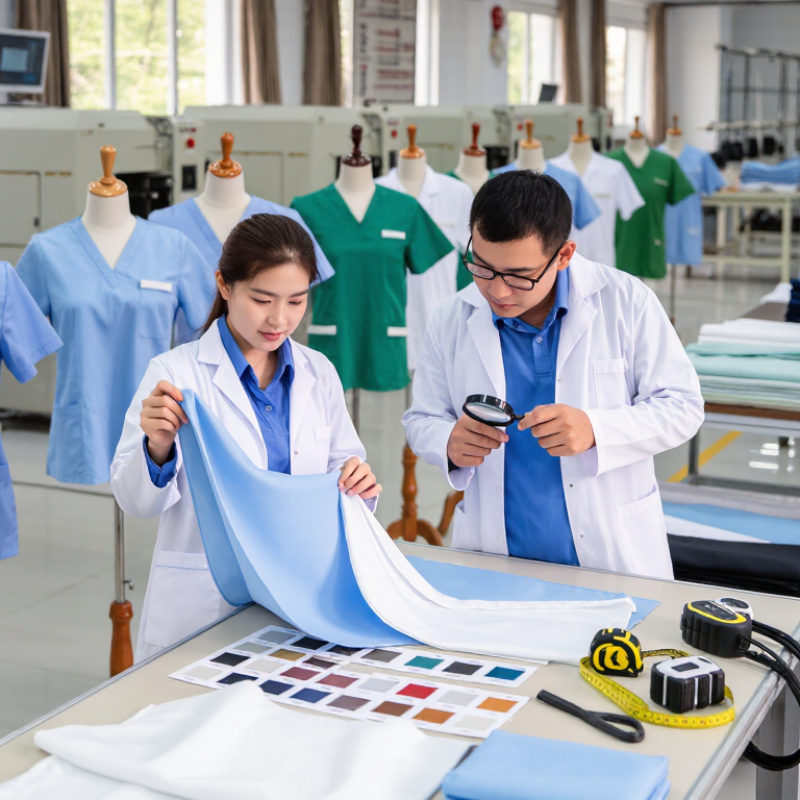
Before contacting a Chinese OEM, define who will wear the garments and where they will work. Scrubs for a warm outpatient clinic need different fabric weight and pocket access than lab coats worn through long shifts. Specify the fiber blend, fabric weight, colors, size range, closures, and embroidery area. Fit matters. Ask for measurements in centimeters and approve a size set on actual wearers, not only a chart.
Set measurable performance targets. For example, request wash testing across 50 cycles and record dimensional change, colorfastness, seam strength, and pilling. Treat 50 cycles as your own purchasing benchmark, not a universal standard. The U.S. Bureau of Labor Statistics reported 562,000 nonfatal injury and illness cases in healthcare and social assistance in 2023; this broad figure does not prove uniforms prevent injuries, but it underscores the demanding work environment. Ask suppliers to document fabric composition, test methods, batch checks, and corrective actions.
Separate everyday uniforms from protective garments. If you need isolation gowns, specify the intended barrier level and evaluate them against AAMI PB70, which defines four liquid-barrier levels. Request pre-production samples, a written inspection plan, minimum order quantities, and realistic lead times. I would avoid demanding every feature at once; some preferences conflict, and I have seen pocket changes affect fit. Start with the essential requirements, then test a sample through your actual laundry process.