You have successfully logged out.

What Is a Surgical Suture and What Types Are Available?
A Surgical Suture may look like a fine thread, but its choice can influence how a wound is supported as it heals. Surgeons consider the tissue, wound tension, healing time, and the needs of the procedure. A suture that works well in one setting may be unsuitable in another. Small details matter: the thread’s thickness, the needle’s curve, and how the material handles beneath gloved fingers.
The history of modern surgery is often associated with William Halsted and his principles of careful tissue handling. A concise paraphrase of that approach is: “Handle tissue gently and preserve its blood supply.” This is a paraphrase, not a verified verbatim quotation. The idea remains useful when considering sutures, though it does not replace clinical judgment.
This guide explains what a Surgical Suture is and how absorbable and non-absorbable materials differ. It also introduces monofilament and braided designs, common needle types, and the practical trade-offs behind each option. Some sutures gradually break down in the body; others are intended to remain until removal or longer-term support is appropriate. The names can sound technical. The differences are tangible: one thread may slide smoothly through tissue, while another may offer a more secure knot.
There is no universal best choice. That point is easy to overlook. Understanding the options can make surgical discussions clearer, but only a qualified clinician can select the right suture for an individual procedure.
What a Surgical Suture Is
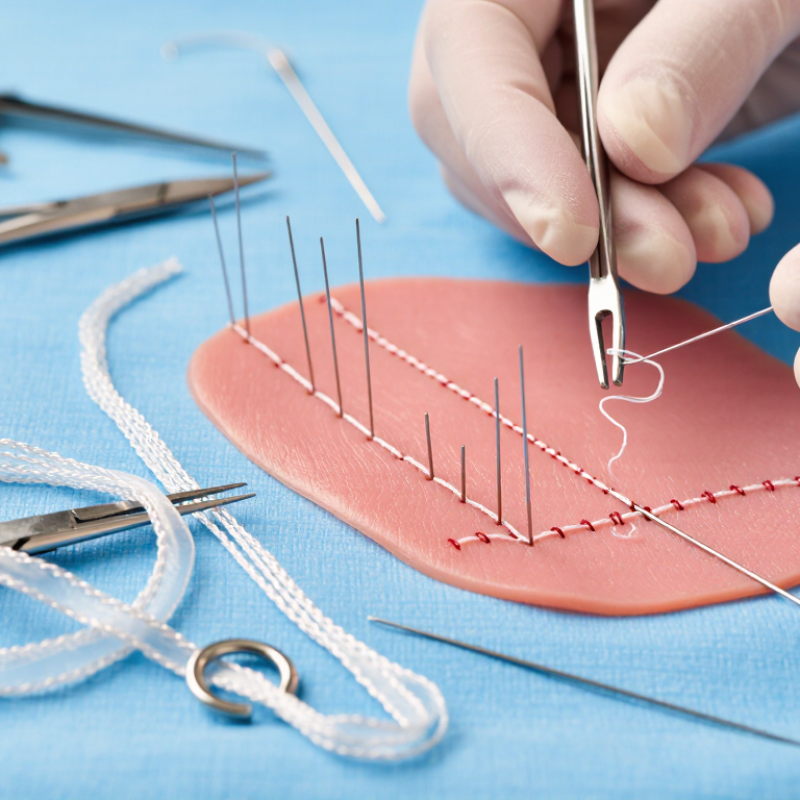
A surgical suture is a sterile thread or strand used to hold tissue together after an incision or injury. It may come attached to a small, curved needle, which helps a clinician guide the strand through tissue. Each pass forms a stitch. The goal is to keep wound edges near one another while the body repairs the area. A suture supports healing; it does not cause healing by itself. Small details matter.
Suture materials vary. Absorbable sutures gradually break down in the body, while nonabsorbable ones may remain in place or be removed later. Some are smooth and monofilament; others are braided, which can affect handling and how they interact with tissue. There is no single ideal suture for every wound. A clinician considers the tissue, wound tension, location, and expected healing time when choosing one. Even a tidy line of stitches cannot guarantee an invisible scar, and healing may differ from person to person.
Related Posts
-

Exploring the Advantages of the Best Surgical Suture for Optimal Healing
-
Elevating Global Healthcare with High Quality Surgical Sutures from China's Leading Factory
-

Top Suture Surgery Supplies for Global Buyers?
-
Mastering Import and Export Certification for Best Suture Supplies in Your Business
-
How Chinese-Made Surgical Needles Set New Standards in Quality and Global Trust
-
Solutions for Sourcing the Best Surgical Needles Worldwide