You have successfully logged out.

China Top Surgical Needles and Sutures Suppliers?
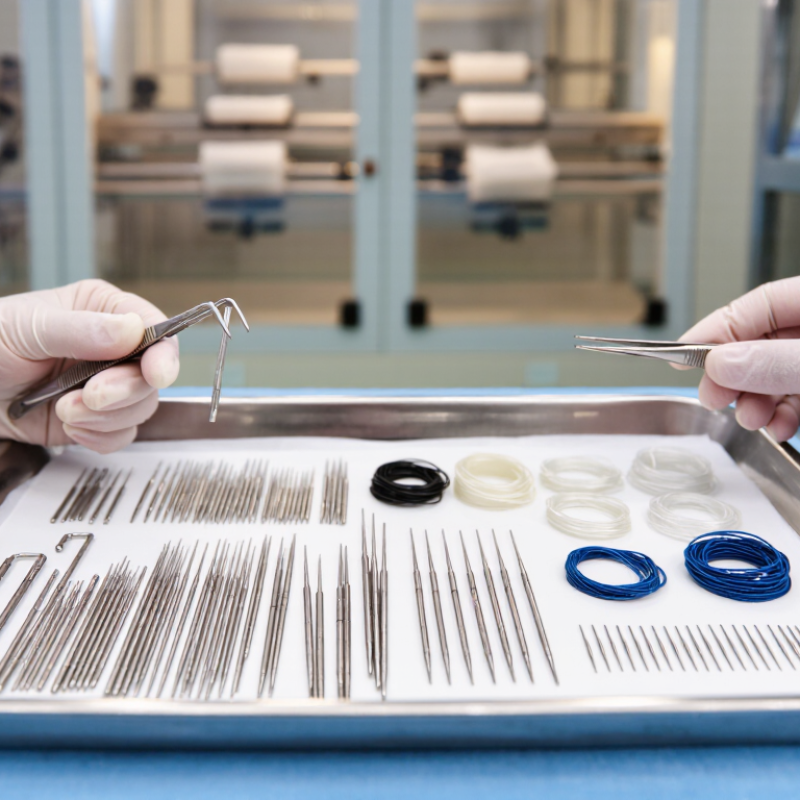
China has become a major manufacturing base for Surgical Needles And Sutures. Its suppliers serve hospitals, distributors, and private-label medical brands worldwide. Yet supplier selection requires more than comparing unit prices.
The Lancet Commission on Global Surgery estimated that over 300 million surgical procedures occur annually worldwide. This volume creates constant demand for reliable needles, absorbable sutures, and non-absorbable materials. Fortune Business Insights reported continued growth in the global surgical sutures market, driven by rising procedures and improved wound-care technology. Market estimates differ, though. That difference deserves attention.
A strong China supplier should demonstrate traceable raw materials, controlled needle curvature, consistent needle penetration, and documented sterilization processes. ISO 13485 certification can support quality management, but certification alone does not prove every shipment is excellent. Buyers should examine audit records, tensile-strength testing, packaging integrity, and complaint-handling procedures. Small details matter. A damaged foil pouch can compromise an otherwise well-made suture.
Surgeon and safety researcher Atul Gawande wrote, “We have an opportunity before us, not just to save lives, but to make care better, safer, and more efficient.” His observation applies directly to procurement decisions. The cheapest supplier may not deliver the lowest clinical risk. Conversely, higher pricing does not automatically guarantee superior performance.
This guide reviews leading China Top Surgical Needles and Sutures Suppliers through practical criteria, including manufacturing experience, regulatory documentation, product range, customization, and export reliability. Some conclusions may remain imperfect, because public supplier data is often incomplete. Careful verification is still necessary.
China’s Surgical Suture Industry: 234 Million Global Operations as Context
China Top Surgical Needles and Sutures Suppliers?
China’s surgical suture sector serves a global market shaped by an important historical figure. A 2008 Lancet study estimated 234.2 million major operations occurred worldwide in 2004. That number is not a current forecast, but it shows the scale of clinical demand. Every procedure depends on consistent needle geometry, controlled tensile strength, and dependable sterility.
China-based suppliers commonly produce absorbable and non-absorbable sutures, including monofilament and braided designs. Strong manufacturers should provide ISO 13485 quality-system evidence, validated sterilization records, and biocompatibility data aligned with ISO 10993. Buyers should also examine needle curvature, penetration force, coating uniformity, and package integrity. Small defects matter. A rough needle eye can damage tissue, while uneven braiding may affect handling.
The World Health Organization’s Global Surgery 2030 report highlights continuing gaps in safe surgical access, especially in lower-resource settings. This creates demand for reliable, cost-conscious products, not merely high production volume. Supplier evaluation should include lot traceability, complaint handling, export documentation, and independent testing. A polished catalog is not enough. Sampling remains essential, and my practical concern is simple: supplier claims can look stronger than the underlying evidence. Surgical procurement deserves slower verification, even when delivery pressure feels urgent.
China Top Surgical Needles and Sutures Suppliers? – China’s Surgical Suture Industry: 234 Million Global Operations as Context
| Evaluation Dimension | Verified Data or Technical Context | Relevance When Evaluating a China-Based Supplier | Reference or Data Basis |
|---|---|---|---|
| Global surgical demand | Approximately 234 million surgical operations were estimated to take place worldwide each year. | The figure provides broad demand context for surgical needles, sutures, wound-closure products, and related sterile devices. | Weiser et al., The Lancet, 2008. |
| Product categories | Core categories include absorbable sutures, non-absorbable sutures, absorbable needles, non-absorbable needles, and pre-attached needle-and-suture assemblies. | A capable supplier should maintain separate specifications, validation records, and traceability controls for each product category. | Common medical-device product classification practice. |
| Absorbable suture function | Absorbable sutures are designed to lose tensile strength and break down in the body over time; the duration depends on the material and construction. | Buyers should request tensile-retention profiles, absorption data, shelf-life evidence, and sterilization validation for the selected material. | Product-specific technical documentation and applicable pharmacopeial requirements. |
| Non-absorbable suture function | Non-absorbable sutures are intended to retain their structure for extended periods, although some materials may gradually change in vivo. | Supplier comparisons should include long-term tensile strength, handling characteristics, surface finish, and tissue-response information. | Material-specific performance characteristics. |
| Suture size system | Under the United States Pharmacopeia sizing convention, a greater number of zeros generally indicates a finer suture; for example, 6-0 is finer than 2-0. | Purchase specifications should define diameter, tolerance, tensile strength, needle attachment, and intended clinical application rather than relying only on size labels. | USP suture nomenclature and product standards. |
| Needle geometry | Important needle attributes include curvature, point type, diameter, length, body cross-section, ductility, and resistance to bending or breakage. | A supplier should provide drawings, dimensional tolerances, needle-point inspection results, and mechanical test records for each needle configuration. | Surgical-needle product specifications and applicable medical-device standards. |
| Sterilization control | Common sterilization methods for sterile medical devices include ethylene oxide and radiation sterilization. Each method requires validated process parameters and routine monitoring. | Request sterilization-cycle validation, residual testing where applicable, batch release records, and evidence that packaging remains intact after sterilization. | ISO 11135 for ethylene oxide sterilization; ISO 11137 for radiation sterilization. |
| Biocompatibility | Biological evaluation considers the nature and duration of contact between the device and the body, including potential cytotoxicity, sensitization, irritation, and systemic effects. | Supplier qualification should include a biological-evaluation report or equivalent evidence for the finished, sterilized product. | ISO 10993 series. |
| Packaging and shelf life | Sterile barrier packaging must protect the product from contamination and preserve package integrity through transport and the stated shelf life. | Review accelerated-aging or real-time-aging data, seal-strength results, distribution testing, labeling controls, and packaging-change procedures. | ISO 11607 series. |
| Quality-management system | ISO 13485 specifies quality-management-system requirements for organizations involved in the design, production, installation, and servicing of medical devices. | Certification should be checked for scope, validity, issuing body, manufacturing site, and the exact product family covered. | ISO 13485:2016. |
| Regulatory documentation | Regulatory requirements vary by destination market and product configuration. Technical files commonly include risk management, verification, validation, labeling, and post-market procedures. | Before ordering, confirm whether the supplier can support the required Chinese, European, United States, or other market documentation without substituting certificates from unrelated products. | Destination-market medical-device regulations and ISO 14971 risk-management principles. |
| Batch traceability | Traceability should link raw materials, needle and suture processing, assembly, sterilization, inspection, packaging, and final release to a defined lot or batch. | Lot-level records reduce recall risk and support investigation of complaints, nonconformities, and delivery-quality issues. | Medical-device quality and traceability best practice. |
Note: The 234 million figure is an historical global estimate published in 2008 and is presented as industry context rather than a current annual forecast. No company or brand performance data are included.
Related Posts
-
China Top 10 Needles And Sutures Manufacturers?
-

Top Suture Surgery Supplies for Global Buyers?
-

Understanding the Importance of Suture Supplies in Modern Surgical Practices
-

7 Essential Tips for Choosing the Right Needles and Sutures for Optimal Patient Care
-
Mastering Import and Export Certification for Best Suture Supplies in Your Business
-

The Ultimate Guide to Choosing the Best Plastic Surgery Suture for Your Practice