You have successfully logged out.

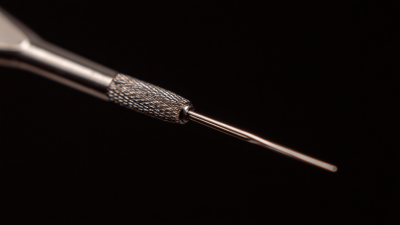
A surgical suture needle may look like a small, simple tool, but its design affects how it passes through tissue. Surgical Suture Needles come in different shapes, sizes, curves, and point styles because procedures involve different tissues and working spaces. A taper-point needle separates tissue fibers as it advances, while a cutting needle has edges designed to penetrate tougher tissue. These descriptions are useful, but they are not the whole story. Small details matter.
Curvature can influence how a needle moves in a confined area, and needle size must suit the task and the suture material. Surgeons and trained clinical teams consider the tissue, procedure, access, and manufacturer’s labeling when selecting a needle. No single design fits every situation. Even familiar categories can feel less clear in real clinical settings than they appear in a chart. That distinction deserves attention. This guide explains the main types of surgical suture needles, what their features are intended to do, and why those differences matter. It offers general educational information, not instructions for choosing a device for an individual patient.
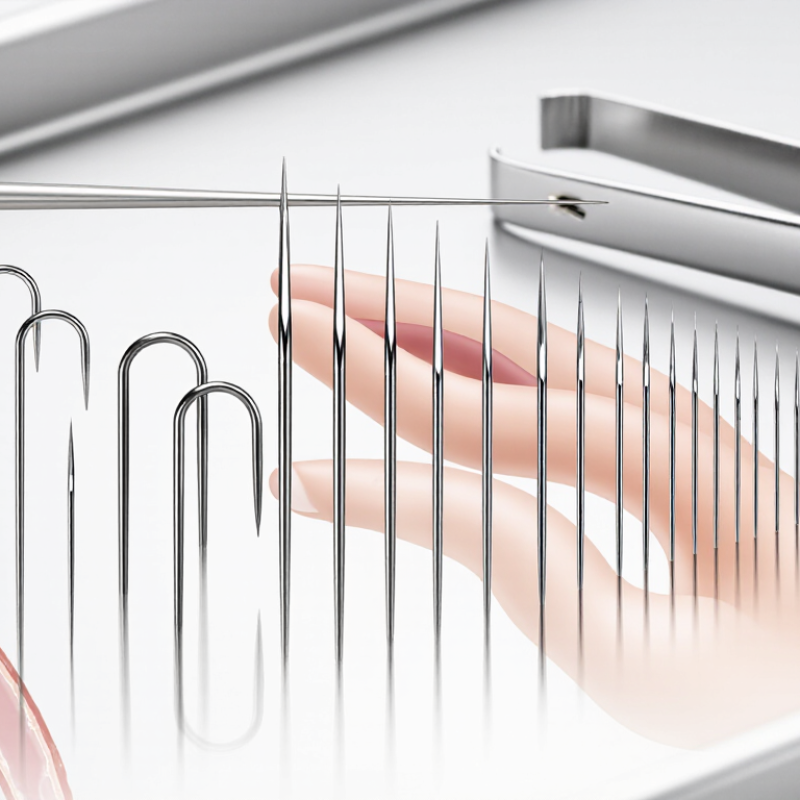
A surgical suture needle carries thread through tissue so a wound can be closed or tissue secured. Its point makes the entry; its body guides the thread along a chosen path. A swaged attachment joins needle and suture directly, leaving less bulk at the junction than an eyed needle. Curved needles rotate through tissue with a wrist movement. Straight needles are advanced more directly. Taper points separate softer tissue, while cutting points are designed for tougher surfaces such as skin. Small differences matter.
Needle choice depends on tissue, access, and the surgeon’s technique. A 3/8-circle curve can suit accessible tissue; a tighter curve may help in a confined space. These are common patterns, not rules for every operation. The WHO’s 2016 Global Guidelines for the Prevention of Surgical Site Infection reported a pooled infection incidence of 11.2% across 55 studies in 20 low- and middle-income countries. That figure does not compare needle types. It does show why needle handling belongs within broader infection-prevention practice. A needle that passes smoothly may reduce unnecessary tearing, but the exact fit can be hard to judge until the tissue is seen. That deserves reflection.
Needle curvature is one design feature that affects how a needle moves through tissue and how easily it can be maneuvered in a surgical space.
How to read this chart: The values show the nominal arc angle of each needle shape: a straight needle has no arc, while curved needles commonly range from a quarter-circle to a five-eighths-circle. Curvature can help with access and needle rotation in different operative spaces. Point design is another factor: for example, taper points separate tissue, while cutting points are designed to penetrate tougher tissue. The appropriate needle depends on the procedure and tissue.
A surgical suture needle has three working parts: the point, the body, and the attachment end. The point enters tissue; the body carries the curve and cutting profile; the end holds the suture, often through a swaged, eyeless connection. Small details matter. A 3/8-circle needle can turn through a confined field, while a 1/2-circle needle may suit deeper access. The surgeon’s view, tissue depth, and instrument angle all affect control.
Needle points are not interchangeable. A taper point separates soft tissue fibers, whereas a cutting point has edges that pass through tougher tissue. Reverse-cutting needles place the cutting edge on the outer curve, which can help limit cut-through at the wound edge. Blunt points may be considered for friable tissue. WHO’s 2016 evidence review reported about 11.8 surgical-site infections per 100 surgical patients in low- and middle-income settings. This figure is not needle-specific; it reinforces the need for careful closure and infection-prevention practice. Shape alone cannot guarantee a good result. Tissue handling still counts. I would not choose a needle by its label alone: the intended tissue and the operator’s technique matter just as much.
A suture needle’s shape helps determine how it passes through tissue and how much it may disturb along the way. Cutting needles have sharp edges designed to cross tougher tissue, such as skin. A reverse-cutting design places its cutting edge away from the wound’s outer surface, which can help reduce tissue pull-through. The difference is small in appearance. It can matter during closure.
Taper-point needles push between tissue fibers rather than slicing them. They are commonly selected for softer tissues, including bowel or muscle, when preserving those fibers is important. Blunt-point needles are used for fragile, easily torn tissues, such as the liver. Curvature also affects access: a tighter curve can help in a confined space, while a gentler curve may suit a more open area. These are practical patterns, not rigid rules. Tissue thickness, condition, and surgical access all influence the choice. Even experienced clinicians may find that real tissue behaves less predictably than a diagram suggests. That matters. The appropriate needle depends on the procedure and the judgment of the trained surgical team.
| Needle design | How the tip or body works | Common tissue applications | Why this design may suit the tissue | Important consideration |
|---|---|---|---|---|
| Taper-point | Round-bodied needle that tapers to a point; it separates tissue fibers rather than cutting a slit. | Soft, relatively pliable tissues, such as bowel, blood vessels, and many internal organs. | Its non-cutting sides can help limit incision-like damage in tissues that can be penetrated by gentle spreading. | May be difficult to drive through dense or tough tissue; needle choice depends on tissue thickness and the procedure. |
| Conventional cutting | Triangular cross-section with a cutting edge along the inner curve of the needle. | Skin and other tissues that are relatively tough or resistant to penetration. | The cutting edges help the needle pass through tissue that may not yield readily to a round-bodied point. | Because the cutting edge faces the inside of the curve, tissue can be more prone to cut-through than with a reverse-cutting design in some settings. |
| Reverse cutting | Triangular cross-section with the cutting edge on the outer curve; the inner curve is less likely to form a cutting edge. | Skin, tendon, and other dense or fibrous tissues where a secure passage is needed. | The edge orientation can help resist the needle tearing through the tissue edge under tension. | It is still a cutting needle, so careful placement and appropriate tension are important. |
| Taper-cut | Cutting point transitions into a round-bodied shaft, combining initial cutting ability with a less cutting body. | Dense, fibrous tissues that are difficult to penetrate with a standard taper-point needle; selected vascular or other specialist repairs. | The cutting tip can ease entry while the tapered body may reduce cutting along the full needle track. | Use is procedure-specific; it is not interchangeable with a standard taper-point or cutting needle in every repair. |
| Blunt-point | Rounded, relatively blunt tip designed to push or spread tissue rather than sharply pierce it. | Friable parenchymal organs, such as the liver or kidney, in selected procedures. | Blunt passage may help reduce accidental puncture or tearing in soft, delicate tissue. | It requires suitable tissue and technique and may not penetrate tougher tissue efficiently. |
| Spatula (side-cutting) | Flat, low-profile needle with cutting edges designed to enter tissue from the side rather than cut vertically through it. | Ophthalmic procedures involving delicate layers of the eye, including corneal or scleral tissue. | The flat profile supports controlled passage through thin tissue planes and can help limit unwanted vertical tissue disruption. | Its specialized geometry is intended for particular delicate-tissue applications, not general-purpose closure. |
| Curved needle: 3/8 circle | Moderately curved arc that is commonly rotated through tissue with a wrist motion. | Accessible tissue surfaces, including many skin and general soft-tissue closures. | The curve provides a practical balance of maneuverability and reach when the operative field is open. | Suitability depends on access, tissue depth, and the surgeon’s preferred technique. |
| Curved needle: 1/2 or 5/8 circle | More pronounced curvature that can help reach tissue in deeper or more confined spaces. | Selected deep-cavity or restricted-access repairs, including some pelvic or oral procedures. | The tighter arc can make it easier to place a stitch when a straight approach or broad wrist movement is limited. | These are curvature options, not point types; the appropriate point and size must also match the tissue and task. |
Key idea: Needle selection depends on tissue strength and fragility, access, the required stitch, and the procedure. This table describes common design principles; clinical choice should follow the operating team’s judgment and applicable guidance.
A needle’s curve determines how it travels through tissue and how much room the surgeon needs. A 3/8-circle needle often suits accessible surfaces, where the wrist can follow a short arc. A 1/2-circle needle can help in deeper, confined spaces, though handling still depends on the approach and anatomy. Straight needles may work well in easily reached tissue. Small differences matter.
Point geometry matters just as much. Taper-point needles separate rather than slice tissue fibers, making them useful in softer tissues. Cutting points have a sharp edge for tougher tissue, such as skin. Reverse-cutting points place the cutting edge away from the wound edge, which may help limit cut-through. Blunt points can be useful in friable tissue. These are practical patterns, not rules; tissue quality and the procedure can change the choice.
Needle control also deserves attention. The CDC estimated about 385,000 needlestick and other sharps injuries among U.S. hospital-based healthcare personnel each year in its 2008 report; this figure covers sharps broadly, not suture needles alone. A well-matched curve may support controlled movement, but it cannot replace careful handling. Real tissue is less tidy. Selection still calls for clinical judgment.
How Surgeons Select a Needle for Each Procedure
Needle choice depends on the tissue, the wound’s location, and the surgeon’s access. A curved needle can rotate through deeper tissue, while a straight needle may suit an easily reached area. Needle points matter, too. Tapered points separate soft tissue fibers; cutting points are designed for tougher tissue. The goal is controlled passage with minimal unnecessary trauma.
Tips: Match needle shape and curvature to the working space. Check that the needle holder grips the body securely, not the tip. A 3/8-circle needle may work well in open access, while a tighter curve can help in confined spaces. These are practical guides, not fixed rules.
Surgeons also consider needle length, suture size, and the delicacy of the tissue. A small needle may offer precision in fine tissue, but it can be difficult to control in a deeper field. A larger needle may improve reach, yet cause more tissue disruption. In practice, selection can involve trade-offs. Even experienced clinicians pause to reassess when visibility or tissue quality differs from expectations. Local protocols and clinical judgment guide the final choice.