You have successfully logged out.

2026 Top Types of Surgical Suture Needles for Buyers?
Choosing Surgical Suture Needles is a practical decision with consequences at the operating table. A needle must pass through tissue cleanly, hold its curve, and match the suture and procedure. Too much resistance can make delicate work harder; a poor curvature match can force awkward wrist movement. Small details matter.
Industry reports offer useful context, but their scope needs care. Grand View Research estimated the global surgical sutures market at approximately US$4.4 billion in 2023 and forecast growth through 2030. That figure covers sutures, not surgical needles alone. Buyers should not treat it as a needle-market estimate. Needle selection still depends on specific factors: taper-point or cutting tip, straight or curved body, alloy, size, and intended tissue. A cardiac needle and a skin needle are not interchangeable simply because both are stainless steel.
This guide compares the main needle types and the trade-offs behind them. It is intended to support informed purchasing, not replace clinical judgment or manufacturer instructions. One limitation deserves attention: no source material was provided to verify a named expert’s needle-specific quotation. Rather than invent one, this introduction relies on clearly identified market data and separates broad market context from product-level evidence. That distinction is worth keeping.
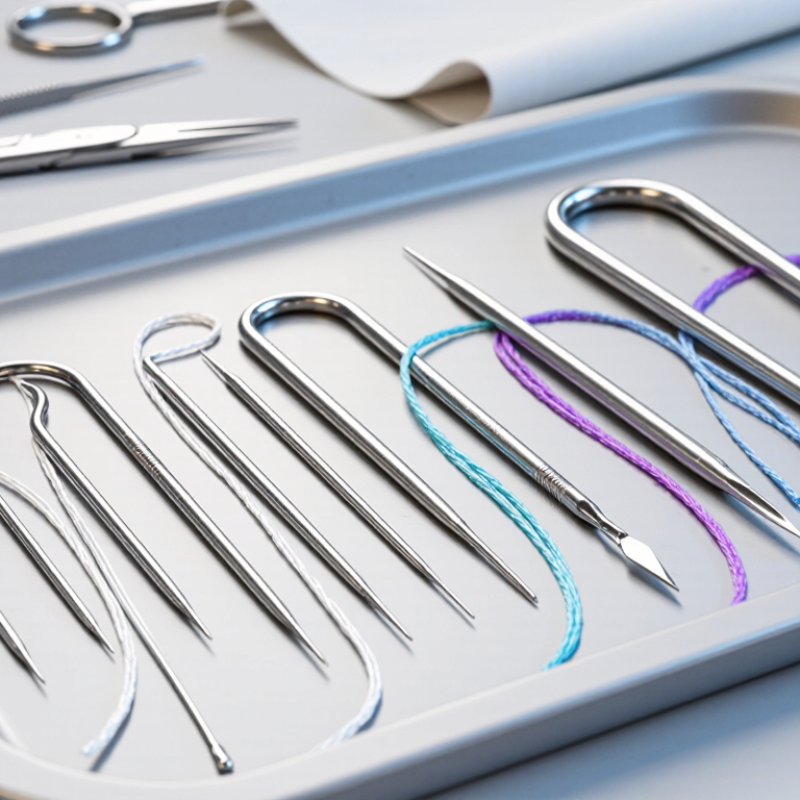
What Surgical Suture Needles Are and How They Are Used
A surgical suture needle is a small instrument that carries thread through tissue so a clinician can close or repair a wound. It may be straight or curved, with a pointed tip and a body designed for controlled handling. Many needles arrive attached to the suture by a crimped connection, which avoids threading the needle by hand. Some have an eye instead. A small detail, but it changes how the instrument is prepared.
Needle shape and tip affect how it passes through tissue. Taper-point needles separate softer tissue fibers, while cutting designs have edges intended to penetrate tougher tissue. Curved needles are common when access is limited; their arc lets the clinician work within a smaller space. Selection depends on the tissue, procedure, suture material, and the clinician’s training—not on needle shape alone. In practice, the needle is held with an appropriate instrument and guided through tissue with controlled movements. The package instructions matter, too. Even familiar tools deserve a careful check before use, because needle curvature and attachment can vary. That sounds basic. It is easy to overlook.
Related Posts
-
7 Tips for Buying Surgical Needles
-
Why Are There Different Types of Surgical Suture Needles?
-
How to Choose Surgical Suture Needles for Global Sourcing
-
What Are the 2026 Top Suture Needle Types for Global Buyers?
-
Navigating Industry Standards: The Gold Standard for Best Suture Needles in Surgical Precision and Safety
-

Mastering Import Export Certification for Best Suture Needles A Comprehensive Tutorial