You have successfully logged out.

Top 10 Needle and Suture Manufacturers in China
Needles And Sutures are small components with substantial responsibilities: they help clinicians close tissue, control bleeding, and support wound healing. Their performance depends on more than a sharp point or strong thread. Material consistency, sterile packaging, dependable supply, and clear product documentation also matter.
The Lancet Commission on Global Surgery estimated that approximately 313 million major surgical procedures took place worldwide in 2012. This widely cited estimate illustrates the scale of surgical care—and the need for reliable instruments and consumables. The World Health Organization’s Global Guidelines for the Prevention of Surgical Site Infection further emphasize evidence-based measures to reduce infection risk. These sources do not rank manufacturers, but they clarify why product quality and manufacturing discipline deserve close attention.
This guide to the Top 10 Needle and Suture Manufacturers in China offers a practical starting point for buyers, distributors, and healthcare professionals. It considers factors such as product range, manufacturing capabilities, quality systems, export experience, and the availability of verifiable company information. A supplier’s catalogue may look impressive; consistent specifications and responsive support matter just as much. No list is perfect. Public information can be incomplete, and a company’s strengths may vary by product line. Readers should confirm current certifications, intended use, and product details directly with each manufacturer before making procurement decisions.
How Surgical Needles and Sutures Are Classified in China
In China, surgical needles and sutures are described by both technical features and medical-device regulatory requirements. These are related, but they are not the same classification system. Regulatory status depends on intended use and risk, so buyers should verify current product documentation rather than infer a category from the product name alone.
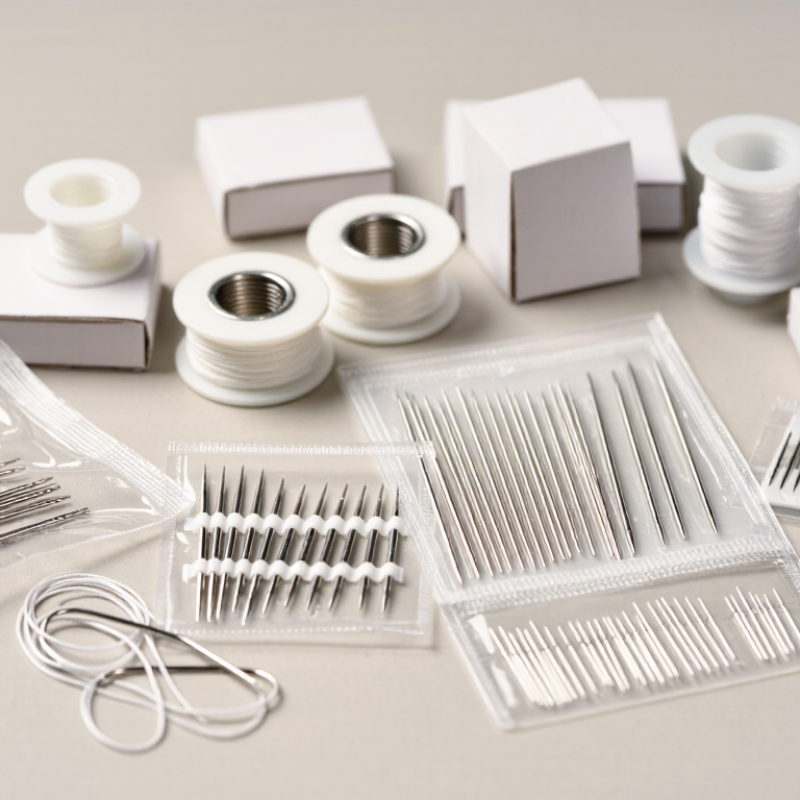
Needle descriptions commonly specify curvature, length, cross-section, and point design. A curved needle may suit confined surgical access, while a straight needle can be easier to handle in accessible tissue. Taper points separate tissue fibers; cutting points are designed to pass through tougher tissue. Details matter. The same needle shape can feel different depending on its size and the surgeon’s technique.
Sutures are commonly grouped as absorbable or non-absorbable, and as natural or synthetic. Their construction may be monofilament or braided, affecting handling, flexibility, and fluid movement along the thread. Packaging and labeling typically identify size, material, needle details, and sterile status. Check them closely. Catalog terminology can vary, and a neat category does not always predict performance in a specific procedure. Clinical selection should follow the intended use and qualified professional judgment.
Top 10 Needle and Suture Manufacturers in China - How Surgical Needles and Sutures Are Classified in China
This table presents ten common surgical suture and needle classification profiles. It is a product-classification overview, not a ranked list of manufacturers; no company or brand names are included.
| No. | Classification Profile | Typical Material or Design | Absorption or Construction | Common Applications | Needle or Selection Notes |
|---|---|---|---|---|---|
| 1 | Synthetic absorbable monofilament suture | Examples include polydioxanone and poliglecaprone | Single filament; typically absorbed through hydrolysis | Soft-tissue approximation where a smooth, low-profile strand is useful | Available with different needle shapes and curvatures; select according to tissue and access |
| 2 | Synthetic absorbable braided suture | Examples include polyglycolic acid and polyglactin | Multiple braided filaments; typically absorbed through hydrolysis | General soft-tissue approximation and ligation, as indicated by the product labeling | Commonly supplied attached to taper-point or cutting-point needles, depending on intended use |
| 3 | Natural absorbable suture | Surgical gut, made from purified collagen of animal origin | Absorbed mainly through enzymatic processes; absorption can vary with conditions and tissue | Selected soft-tissue applications when an absorbable material is appropriate | Check the labeling for material origin, treatment, absorption information, and applicable restrictions |
| 4 | Nonabsorbable monofilament suture | Examples include polypropylene and polyamide | Single filament; intended to remain unless removed or otherwise managed | Skin closure and other soft-tissue applications, depending on material and clinical judgment | May be paired with cutting or taper-point needles; the appropriate pairing depends on tissue |
| 5 | Nonabsorbable braided suture | Examples include polyester, silk, and braided polyamide | Multiple interlaced filaments; generally retains its structure over time | Soft-tissue approximation or ligation where a braided, nonabsorbable strand is selected | Needle attachment and coating, if any, vary by product; consult the device labeling |
| 6 | Metallic suture | Typically stainless-steel wire | Nonabsorbable metallic strand; supplied in formats suited to the intended procedure | Selected applications such as sternal closure or orthopedic procedures | Needle and wire configuration should match the procedure and the product instructions |
| 7 | Taper-point surgical needle | Rounded body that tapers to a point | Needle-point classification; penetrates by separating tissue rather than cutting a slit | Many soft tissues where cutting edges are not required | Curvatures commonly include 1/4, 3/8, 1/2, and 5/8 circle; availability varies |
| 8 | Cutting or reverse-cutting surgical needle | Triangular cross-section with cutting edges; edge orientation differs by design | Needle-point classification designed to cut through tougher tissue | Commonly selected for skin and other tissue requiring a cutting point | Needle curvature and point style should be chosen for the tissue and surgical approach |
| 9 | Blunt-point surgical needle | Rounded, non-sharp tip | Needle-point classification intended to reduce sharp-point penetration | May be used for selected friable tissues, such as liver, when clinically appropriate | Availability and indications are product-specific; follow the device instructions |
| 10 | Spatula-point surgical needle | Flat needle body with cutting edges along the sides | Specialized needle-point design that spreads tissue layers during passage | Commonly associated with ophthalmic procedures, including selected corneal or scleral work | Choose the profile and curvature for the specific ophthalmic procedure and tissue |
Classification terms describe common material, construction, and needle-design categories. Product availability, indications, size systems, and regulatory status can differ; confirm details in the applicable Chinese registration or filing information and the manufacturer’s labeling.
Related Posts
-
Understanding the Key Types and Uses of Suture Materials in Modern Medicine
-

Top Suture Surgery Supplies for Global Buyers?
-
7 Secrets to Finding the Best Plastic Surgery Suture for Your Practice
-
Excellence in Manufacturing: Discover China's Premier Suture Needles for Global Healthcare
-
How to Choose Needles and Sutures for Global Sourcing?
-
7 Tips for Buying Surgical Needles